BEST GAMES
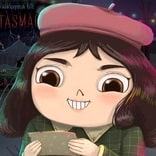
Little Misfortune
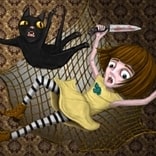
Fran Bow 4
Little Misfortune 2

Among the Sleep
SIMILAR GAMES

Little Misfortune Full Game
Night in the Woods

Little Nightmares 2025

Sally Face

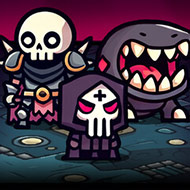
The moment you load into Noobs Are Coming, something clicks that most action roguelikes never deliver: you are not the scrappy underdog clawing toward a final boss. You are the Final Boss, and a horde of hapless noobs is coming directly for your dungeon. The role reversal sounds like a gimmick, but the game builds an entire design philosophy around it — every Boss Pattern you equip, every minion you summon, every spikeball you send rolling across the arena exists because you are the thing that should never, ever be defeated.
| Genre | Arena roguelike |
| Platform | Windows, Linux |
| Mode | Single-player, Co-op (up to 4 players) |
| Run length | Under 30 minutes |
| Playable bosses | 45+ |
The core loop is wave survival with a build-crafting layer sitting on top of it. Waves of noobs — those relentless, underequipped MMORPG adventurers — pour into the dungeon arena, and your job is to collect the souls they drop, visit the shop between waves, and assemble a combination of Boss Patterns that keeps you alive while ideally breaking the game in half. The shop is randomised every run, which means no two sessions look the same. One run you are growing plant minions with a watering can and turning noobs into golden statues. The next you are swinging a chain spikeball with physics that launches enemies across the arena in ways that feel genuinely unscripted.
Boss Patterns come in three broad flavours: active attacks that you trigger directly, passive buffs that quietly reshape your stats, and minion summons that fight alongside you. The real skill in Noobs Are Coming lives in reading which combination of those three layers produces a working synergy rather than a pile of unrelated abilities. A cloud-generating pattern that does nothing by itself becomes the backbone of a build once you pair it with an ability that uses moisture stacks. Players in the community call these moments “breaking the build,” and finding one is the central high the game is designed around.
Early waves give you room to experiment. The noobs that show up in the first minutes are disorganised and slow enough that even a half-assembled build survives contact. The pressure mounts quickly after that — boss heroes with genuine threat potential start appearing mid-run, requiring you to reposition rather than stand still and watch your passive abilities handle everything. New players consistently underestimate how much movement matters. Noobs Are Coming is not a game where you plant yourself in a corner; the arena demands constant drift and spatial awareness even when your screen is already full of projectiles.
Selecting a boss character in Noobs Are Coming is the most consequential decision you make before a run starts. Each of the 45 playable bosses brings a fundamentally different mechanical identity, not just different stat numbers. One boss whose mini-me clone mirrors every attack doubles your output at the cost of making positioning twice as complicated. Another leans into the Gun tag, meaning Gun-typed Boss Patterns interact differently with it than they would with a boss built around Laser or Water. Community players track these tag interactions carefully because they determine which shop offerings are worth buying and which can be safely ignored.
The character merge feature, which unlocks once you have recruited 15 bosses, combines two character effects into a single hybrid. This is where the game’s theorycrafting expands into something that keeps Discord servers active weeks after a first playthrough. Merging two synergistic characters produces combinations that the designers clearly expected, but occasionally you discover pairings that produce emergent results that feel closer to exploits than intended builds. The community calls these “broken builds” without complaint — finding one is treated as a skill reward rather than a flaw.
Difficulty scaling affects every boss differently. On the two difficulty levels available in the demo version, a build that comfortably carries one boss to the end of a run may crumble completely on another because the defensive passive it relied on no longer covers enough of the arena. Returning players who have invested time into specific boss archetypes will notice this variance long before casual players do, and it keeps the roster feeling genuinely wide rather than decorative.
Stack the Amount stat high enough in Noobs Are Coming and the screen fills with duplicates of your attacks until the framerate becomes a debate topic. Stack the Size stat past a certain threshold and your boss character occupies a genuinely absurd portion of the arena. The game is designed to accommodate and even encourage both outcomes. There is a dedicated item called the Cheater Item that allows you to stack unique items multiple times, which exists specifically to help players push their builds past the point of balance and into the realm of spectacle. The community celebrates this rather than patching it away, which says something about what kind of game this is.
Weapons in this game include a watering can that grows plant monsters, a gun that fires standard projectiles, a turret that deploys autonomously, and a transformation ability that turns noobs into sheep before they can reach you. Using all of these simultaneously, combined with two or three passive synergy buffs and a summoned spider swarm, produces the kind of chaos that screenshots badly and plays wonderfully. Players who come from Brotato — the game Noobs Are Coming draws clear inspiration from — will recognize the structure immediately but find the physics layer and the transformation mechanics add enough texture to justify the comparison rather than collapse under it.
One honest observation worth making: the soundtrack loops noticeably during longer sessions. It is a minor criticism that multiple reviewers have flagged, and it is fair to mention because the rest of the audio design — the dark fantasy synthesizer score, the pixel art sound effects — does a solid job establishing mood. The music repetition becomes apparent roughly 40 minutes into a run, which matters more in Endless Mode than in the standard sub-30-minute sessions the game is built around. It does not undermine the experience, but it is a real thing that players notice.
Four-player local co-op with Steam Remote Play Together support transforms Noobs Are Coming from a focused solo roguelike into something closer to a party game with roguelite bones. The co-op sessions introduce a soccer-like dynamic where you can literally kick the wrecking ball between bosses before launching it into a group of noobs. This is not a metaphor — the physics system handles the ball as a real object that responds to multiple bosses interacting with it simultaneously, and the results range from efficient to chaotic in ways that depend entirely on how coordinated your group is.
Twitch Streamer Mode integrates chat messages directly into the game as in-game noob taunts, which appear as MMORPG-style chat bubbles above the enemy horde. Content creators who have used this feature report that it creates a feedback loop where the audience becomes invested in the run in a direct way — their names appear on-screen attached to enemies, which produces the kind of interaction that streaming a solo game rarely generates. For players who primarily play alone, this mode is irrelevant. For anyone with an audience, it is a genuine value-add rather than a checkbox feature.
Balance updates have been frequent throughout the early access period — over 140 updates shipped in the first year — and some of those patches have shifted community sentiment notably. The overall review score sits at a strong positive rating, but the recent review window reflects some frustration from players whose preferred builds were adjusted. This is the natural friction of a live-service roguelike that is actively being tuned, and whether you experience it as a problem depends on how attached you become to specific synergies before the patches arrive.
The shop in Noobs Are Coming refreshes between every wave, and the biggest beginner mistake is buying the highest-damage option available without checking whether it carries a synergy tag that connects to anything else in the current build. A Boss Pattern with the Water tag does nothing special in isolation. Paired with a cloud-generating ability that applies the Water condition to noobs before they reach you, the same pattern multiplies in effectiveness. Learning to read tags before reading damage numbers is the transition that separates early struggling runs from the first run that genuinely clicks.
Souls are the currency dropped by defeated noobs, and managing them between waves — deciding whether to spend now on a defensive passive or save for a higher-tier weapon appearing two waves later — is the game’s secondary skill layer. Players who spend every soul immediately tend to plateau at a stable but unspectacular mid-run build. Patience with the shop, particularly early in the game before the boss heroes appear, rewards players with the build foundations they need to handle the escalating difficulty of later waves.
Minion summons are consistently undervalued by players new to Noobs Are Coming. Spider swarms, plant monsters, and turrets do not feel flashy compared to the physics-based chain spikeball or the transformation abilities, but they function as persistent area denial tools that allow your boss character to focus on positioning rather than direct combat. By the time the boss heroes start appearing mid-run, players who built around minion summons have a significantly easier time because the arena is already partially controlled. Players who ignored summons in favour of pure offensive patterns often reach the same wave and suddenly feel the difficulty spike acutely.
Yes, significantly. The character merge combines two boss character effects into one, which changes which synergy tags become relevant for a run. If one of the merged characters benefits from the Water tag and the other from the Gun tag, the merged boss interacts with both pattern types — which broadens the useful items in each shop visit. Players who have unlocked the merge feature report that it effectively doubles the number of viable build directions available per run, making the theorycrafting layer considerably deeper than what the base roster alone offers.
The Cheater Item allows you to stack unique Boss Patterns multiple times, bypassing the normal rule that prevents duplicates. It is an intentional game mechanic rather than an exploit — the item appears in shops like any other and is priced accordingly. Stacking a powerful pattern three or four times using the Cheater Item produces builds that are clearly beyond the game’s standard balance ceiling, which is precisely the point. The Amount stat and Size stat, when pushed through Cheater Item stacking, create the screen-filling chaos that the community treats as the game’s highest reward state.
The solo experience is the primary design target. Wave survival, shop management, and build-crafting across a 30-minute run form a complete and satisfying loop that does not require other players to function. Co-op adds the wrecking ball soccer physics and the chaos of four bosses building simultaneously without coordination, which is a different kind of fun rather than a better version of the same game. Players who enjoy methodical build planning will find the solo mode more rewarding. Players who want unscripted chaos with friends will find co-op delivers that without the solo mode being diminished by comparison.
Noobs Are Coming rewards patience with the shop over raw aggression, and that tension between spending souls now versus holding for a better synergy is what gives each run its own narrative arc. The run where you discovered that your plant minions, combined with a cloud ability and a single Water-tagged Boss Pattern, could cover the entire arena with persistent damage — that run sticks with you because you built it rather than stumbled into it. The 45 bosses, the merge system, and the physics layer mean the next run already has a different shape waiting.