BEST GAMES

Little Misfortune

Fran Bow 4
Little Misfortune 2

Among the Sleep
SIMILAR GAMES

Little Misfortune Full Game

Night in the Woods

Little Nightmares 2025

Sally Face





In Last Report you start with a stack of camera reports on your desk, a guidebook you will read once and probably never open again, and a walkie-talkie that crackles with John’s voice explaining what your shift involves. The setup is mundane by design. You are William, a night-shift ranger at Among Green Trees National Park, returning to work after a break, and nothing about your first report suggests that anything in that park is anything other than routine violations and parking infractions. That changes. It changes specifically, and the change is built into the paper on your desk.
| Genre | Psychological Horror / Point-and-Click |
| Setting | Among Green Trees National Park |
| Protagonist | William |
| Reports to file | 51 total |
| Approximate length | 1–2 hours |
Every report in Last Report follows the same structure. You take a sheet from the stack on William’s desk, open the report app on the monitor, and cross-reference what the camera captured against the information printed on the form — date, sector, image content. You flag inconsistencies, categorize the violation type, and submit. Early in the game this feels like administrative routine. There is a real satisfaction to matching the photo to the field correctly, the same pull that games like Papers, Please used before Last Report borrowed and simplified the mechanic for a shorter, horror-specific context.
The system reveals its actual purpose gradually. By the time the fifth or sixth report lands on your desk, anomalies start appearing — images that do not match the date they were supposedly captured, sectors that show activity no camera should have recorded, details in the background of photos that the report description completely ignores. William’s job shifts from classification to interpretation, and you begin checking each new report not just for the obvious violation category but for signs that what you are looking at is not what it is presenting itself as. That shift in reading posture is the game’s central tension, and it is built entirely from paperwork.
One detail that players who have spent time with Last Report consistently mention: the flicker of the monitor changes between sessions. Early in the shift, the screen is stable. As the reports progress and the content becomes more disturbing, the monitor begins glitching in ways that are subtle enough to initially feel like a display artifact rather than a deliberate signal. Most players have the exact same experience — dismissing the first flicker as a technical issue and only recognizing it retroactively as a game mechanic. That recognition is the game’s best moment of environmental horror.
John is William’s colleague and the primary human voice in Last Report outside of William himself. The walkie-talkie conversations with John serve two functions simultaneously: they provide the backstory that contextualizes what William is experiencing, and they gradually become unreliable as a source of information. Early conversations with John are warm and grounded — the kind of check-in radio chat that would feel at home in any normal night-shift setting. By the mid-game, something shifts in the quality of those transmissions in a way the game leaves deliberately ambiguous.
Players who pay close attention to John’s later transmissions notice that certain details he mentions contradict information visible in the reports William has already processed. Whether this means John is lying, compromised, or simply wrong is never made explicit, and that ambiguity is what the game’s horror depends on. Among Green Trees National Park has a history that the reports are slowly assembling into a picture, and John’s voice becomes part of that picture in ways that make you want to go back and re-read transmissions you dismissed earlier. The walkie-talkie is not a tutorial device. It is a layer of evidence.
The broader community debate about Last Report often centers on whether the John relationship is developed enough to carry the emotional weight the ending asks you to feel. Players who found the narrative compelling argue that John’s characterization is sufficient for a one-to-two hour game. Players who felt let down by the ending point to the fact that most of what you learn about John comes through implication rather than actual screen time. Both readings are valid, and the game does not obviously try to resolve the ambiguity — it leaves the character positioned where it needs him for the story to function.
Last Report contains 51 reports in total, and accurate classification of all 51 — combined with finding the clock and obtaining the crystal — is the requirement for reaching the true ending, titled “The Light Holds… For Now.” This is not communicated explicitly during a normal playthrough, which means most first-time players will complete the game through one of the standard endings without knowing the full scope of what the report-accuracy score affects.
The accuracy system is more forgiving than it initially appears. Steam community threads note that players trying to submit wrong reports intentionally for the bad ending sometimes accidentally classify reports correctly. The form cross-referencing is intuitive enough that correct answers tend to emerge naturally from careful reading, and incorrect answers usually require genuine inattention rather than deliberate misfiling. This is both a design strength and a commonly cited weakness: if wrong answers are hard to submit accidentally, the game’s stated branching feels less meaningful than it implies.
Once you have a perfect report score and have used the clock, the crystal appears in the reports themselves — an item that cannot be obtained through any other route. The file explaining how to use the crystal requires a code: 225, a number that appears in the bad-ending path through the file about the previous ranger, or in the 1998 doctor file through a photograph of the cabin’s walls. The fact that most players discover this detail from a Steam guide rather than from playing is itself revealing — Last Report’s true ending is better as a discovery than as an instruction.
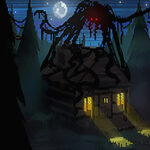
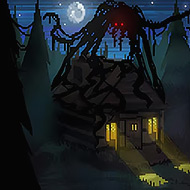
The pixel art in Last Report is doing significant work. The desk environment — reports, monitor, lamp, shredder, coffee mug — is rendered with enough detail that each object is readable and each interaction feels grounded. The park camera feeds visible on the monitor are intentionally low-resolution within the already pixelated art style, which gives the images a layered quality: you are watching a lo-fi camera capture within a pixel art representation of a monitor screen. When something appears in those camera images that should not be there, the visual noise of that double-layered presentation makes it harder to immediately confirm what you are seeing. That uncertainty is deliberate and effective.
The radio static and the rain heard throughout most of Among Green Trees’ night shift establish a texture of isolation without ever requiring William to physically leave his desk. Horror games that confine the player to a fixed location often struggle with monotony, but Last Report sidesteps it through audio pacing — the static increases, the rain shifts, and the silences between walkie-talkie conversations become longer as the shift progresses. Players who completed the game describe a specific moment when the silence after a transmission suddenly felt different from the silences before it. That difference is communicated entirely through sound, with no visual change at all.
One honest limitation that the Steam community raises frequently: the sound design and atmosphere are doing most of the heavy lifting that the gameplay cannot. The report-filing mechanic, while initially compelling, does not evolve in complexity across the 51 reports. The cross-referencing required in report 40 is not meaningfully more demanding than report 10. Players who came wanting a deepening puzzle system — more complex fields, contradictory sources that require reconciliation across multiple reports — will find that Last Report keeps the mechanic flat so the story can escalate instead. Whether that trade-off works depends entirely on whether the story pays off for you.
Last Report has multiple endings, though the community’s consensus is that the divergence between them is less substantial than the setup implies. The standard ending, the bad ending, and the true ending all follow from the same desk and the same reports, but the conditions that route you toward each one — report accuracy, item collection, code discovery — are not clearly signaled during play. First-time players tend to reach the standard ending and only discover the true ending exists through the Steam achievement list or community guides.
The true ending requires the 225 code to open a locked file on William’s computer. That code is traceable in the game itself through two separate routes, but the context that makes 225 meaningful — the scribbled photograph in the 1998 doctor file, or the muttered words of a previous ranger — only becomes significant if you know what you are looking for. Most players do not know what they are looking for on a first playthrough. This is either a design choice that rewards replaying with full knowledge or a structural opaqueness that makes the true ending feel gatekept. Community opinion splits almost exactly down the middle on that question.
Most players complete Last Report in under two hours on a first playthrough, reaching one of the standard endings without discovering the crystal or the 225 code. A second playthrough focused on the true ending, with accurate report classification across all 51 filings and intentional item collection, typically adds another thirty to sixty minutes depending on how quickly the player navigates the code discovery in the 1998 doctor file. Players attempting full achievement completion — including intentional wrong answers for the bad ending route — often log three to four hours total across multiple runs.
Report accuracy in Last Report determines which ending William reaches, but the individual reports themselves do not produce visible branching during the main playthrough. Submitting a wrong report does not trigger a different scene or change John’s dialogue on the walkie-talkie. The consequences of accuracy are stored silently and resolved only at the ending sequence, which is why most players do not realize their filing decisions have been accumulating weight until the final moments of the shift. For players expecting real-time consequences from the report system — the kind of immediate feedback that Papers, Please delivers — the delayed impact is a common point of disappointment.
The crystal is an item that appears in William’s reports only after achieving a perfect accuracy score across the full report stack and using the clock on the desk. It does not appear in a normal or bad-ending playthrough. To use the crystal, the player opens the locked file on William’s computer with the code 225 — discoverable through either the 1998 doctor file photograph or the previous ranger’s documented words — which provides instructions for the crystal’s function in the true ending sequence. Players who have the crystal but cannot get the file to open are almost always missing the code, not the crystal itself.
Last Report lands hardest on players who let the Among Green Trees night shift actually settle around them — who read John’s walkie-talkie transmissions rather than clicking through them, who notice the monitor flicker before it becomes obvious, who process what is in the background of those grainy camera images before the report form tells them something is wrong. William’s desk is a small space, and the game keeps you there for the entire shift, which is either its greatest constraint or its most effective horror tool depending on how much you let the silence between radio calls do its work.