BEST GAMES

Little Misfortune

Fran Bow 4

Little Misfortune 2

Among the Sleep
SIMILAR GAMES

Little Misfortune Full Game

Night in the Woods

Little Nightmares 2025

Sally Face







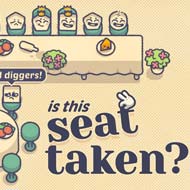
You have placed the sleepy passenger by the window, away from the loud ones, which seems right — and then you notice that the chatty circle in row two refuses to sit anywhere that is not directly beside a friend, and the only available seat next to that friend is the one you just filled. In Is This Seat Taken?, the puzzle never announces that it is about to get complicated. It just quietly blocks you and waits for you to notice. This cozy logic puzzle game drops players into seating scenarios ranging from crowded buses to wedding banquets and asks them to satisfy a group of hilariously specific characters — no timers, no score pressure, just the gentle task of figuring out who belongs where.
| Genre | Logic puzzle / Cozy |
| Platform | Windows (itch.io) |
| Protagonist | Nat, a diamond-shaped aspiring actress |
| Settings | Buses, cinemas, wedding receptions, taxi cabs, banquets |
| Pressure | No timers, no leaderboards |
Each level in Is This Seat Taken? presents a seating layout and a group of characters waiting to be placed. Every character comes with a set of preferences — one wants a window seat, another refuses to sit near someone loud, a third will only sit beside a specific friend, and a fourth insists on a corner. The mechanic is drag-and-drop: pull a character from the waiting area into an available seat and watch whether the placement satisfies or conflicts with their stated conditions. The game is not timed and does not penalize wrong placements. You can move anyone at any time.
What makes the game interesting is the chain of dependencies. Placing one character in a seat does not just satisfy that character — it reshapes the available options for everyone else. A talkative character placed in the middle section of a bus may immediately create discomfort for a quiet character you had planned to seat nearby. This is the puzzle design’s core mechanism: every decision is also a constraint on future decisions, and a level that looks solvable on first glance can become genuinely blocked if the early placements close off a necessary configuration later. Players who charge through early levels by instinct hit a wall around the cinema and wedding reception scenarios, where the number of overlapping preferences makes sequential trial-and-error slow and unreliable.
The progression follows Nat, a diamond-shaped aspiring actress traveling across cities, with each setting introducing a new cast of characters and a new spatial layout. The narrative is light — Is This Seat Taken? is primarily a puzzle game — but it provides context for why this particular group is trying to share this particular space, and that context makes the characters’ preferences feel grounded rather than arbitrary. A sensitive-nosed party guest refusing to sit next to someone wearing too much cologne is funny in a way that a generic preference icon is not, and the game leans into that relatability throughout.
The single technique that separates players who breeze through Is This Seat Taken? from players who get stuck and feel like the puzzle is unfair is reading the full constraint map before placing a single character. Each character’s preferences are visible before placement begins. Players who scan all of them first — identifying which characters have the fewest valid options — can place the most constrained characters first and build outward from there. This is a standard logic puzzle approach, but Is This Seat Taken? does not teach it explicitly, and players who discover it mid-puzzle often report it as the moment the game shifted from frustrating to satisfying.
Characters who require a specific neighbor are the highest-priority placements because they eliminate two seats simultaneously: their own and their required neighbor’s. Characters who simply want a window seat or a corner are more flexible and should be placed last, after the more demanding preferences have been anchored. Once you start reading the layout this way — most constrained first, most flexible last — the puzzle structure becomes legible, and levels that seemed impossible on first attempt often resolve in a single careful pass.
Players who enjoy constraint-satisfaction puzzles and logic games find Is This Seat Taken? immediately rewarding for this reason. The puzzle design has genuine depth despite the absence of any numerical scoring or timer pressure. Players who prefer more freeform puzzle games sometimes find the preference chains slightly rigid — if a level has one valid solution and you have placed one character incorrectly, the feedback can feel like being told you are wrong without being told why. This is an honest criticism that appears in player discussions, and it is worth noting that the game’s no-pressure framing can occasionally work against it by making restarts feel more arbitrary than they need to be.
The game moves through a range of social spaces, each with its own spatial logic. A bus has rows and window seats, which creates a clear axis of preferences — aisle versus window, front versus back. A cinema introduces different sight line concerns. A wedding banquet involves tables rather than rows, which changes how “next to” and “across from” work as preference categories. Each new setting is not just a visual change; it genuinely restructures which types of preferences are most constraining, because the geometry of the space determines what being “near” or “far” means.
The taxi cab scenario is where the game’s humor is most concentrated. With very few seats and characters whose preferences have no room to compromise, the taxi cab levels make the absurdity of the premise fully visible. Two people who refuse to sit near each other, crammed into a vehicle that fits four, with a third character who will only take the front seat — the scenario works as both a puzzle and a comedy sketch about the specific misery of shared rides.
Once the full range of settings has been introduced, Is This Seat Taken? rewards players who have internalized the spatial vocabulary of each one. Early in the game, the bus layout required reading because the window-seat and aisle-seat distinction was new. By the time the wedding banquet scenarios arrive, that distinction is automatic and the cognitive load has shifted entirely to managing the social relationships between characters — who must sit with whom, who absolutely cannot, and what to do when those two requirements share one seat.
Is This Seat Taken? earns its reputation as one of the coziest logic puzzle games in its niche not because the puzzles are easy — some of the later banquet arrangements require careful multi-step reasoning — but because the pressure architecture is genuinely absent. Nat’s journey from city to city gives the puzzle sequence a shape without demanding that you treat the game as anything other than a pleasant afternoon problem. The moment you find the configuration that satisfies the last unhappy character and every preference icon turns green is the reward the game is built around, and it delivers that moment reliably enough to justify the occasional restart.