BEST GAMES

Little Misfortune

Fran Bow 4

Little Misfortune 2

Among the Sleep
SIMILAR GAMES

Little Misfortune Full Game

Night in the Woods

Little Nightmares 2025

Sally Face







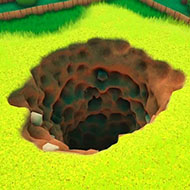
A Game About Digging A Hole starts with one of the most disarming premises in recent simulation gaming: you bought a house, there is a large red X in the backyard, and someone has left you a note suggesting there is treasure buried beneath it. The Super Mega Digger 3000 Ultimate 2.0 sitting in your garage is, at this moment, little more than a hand-sized trowel barely capable of shifting topsoil. What follows is roughly 90 minutes of progressive excavation, ore collection, equipment upgrades, and — if you make it to the bottom — a mystery that the game has been quietly building since the first shovelful of dirt.
| Genre | Mining simulation |
| Platform | Windows, Xbox Series S/X, iOS, Android, Nintendo Switch |
| Mode | Single-player |
| Approximate playtime | Under 2 hours |
| Total user reviews | 90% positive (11,000+) |
The rhythm of A Game About Digging A Hole is deliberate and almost meditative. You descend into the hole using the Super Mega Digger 3000 Ultimate 2.0 to break earth and collect whatever ores appear in the cross-section. Your inventory fills. Your battery drains. You jetpack back to the surface and sell your haul at the barn, then study what upgrades have become available before heading back down. The loop repeats with each iteration reaching slightly deeper, carrying slightly more, staying underground slightly longer. It is a classic upgrade spiral dressed in the quietest possible aesthetic — no enemies in the early sections, no timers, no competitive element.
Beginners most often make the same two mistakes. The first is ignoring battery management in the early game, treating the battery like an afterthought and then running out of charge deep underground with a full inventory and no efficient way back to the surface. The second is spending upgrade currency on inventory space before upgrading the Super Mega Digger 3000 Ultimate 2.0 itself. A larger bag is useless if the drill cannot efficiently break the denser rock layers that appear as you descend past the first few metres — the mid-game geology becomes significantly harder to work through with an underpowered tool, and players who delayed the drill upgrade consistently report hitting a wall around the same depth.
The jetpack deserves its own mention because it changes character as the game progresses. Early on, it is straightforward vertical transport — you hit the surface, sell, come back. By the time you are working deeper sections where the hole has grown wide enough to require lateral movement underground, the jetpack becomes a navigation tool rather than just an exit button. Running low on jetpack fuel at significant depth with a depleted battery and a full inventory is the most common failure state the game produces, and it happens most often to players who stopped monitoring their resources because the early sections never punished inattention.
The ore types shift as depth increases. Surface and near-surface layers yield common stones and basic minerals that sell for modest amounts at the barn — enough to fund early upgrades but not enough to accelerate through the equipment tree quickly. Deeper sections introduce denser and more valuable materials, and the appearance of larger rock formations that the Super Mega Digger 3000 Ultimate 2.0 cannot break without dynamite becomes a practical obstacle that requires planning. Dynamite is consumable and available from the barn shop, which means resource management extends to your explosive supply as well as your battery and inventory.
Lights become necessary at depth. The hole gets dark below a certain point, and navigating without additional illumination makes it genuinely difficult to identify ore deposits in the surrounding rock face. Players who descend aggressively without purchasing lamp upgrades find themselves working by feel rather than by sight, which slows the collection process considerably. The gradual dimming of the environment as you go deeper is one of those details that A Game About Digging A Hole handles well — it does not announce itself, it simply happens, and the moment you notice the light has changed is the moment you realise you needed to have prepared for it earlier.
There are also moles. They appear in the deeper levels and interact with the environment in ways that the game does not explain in advance — specifically, dynamite does not work reliably in the sections where moles are active. Players who discover this by attempting to blast through a rock formation in the wrong zone lose the dynamite charge and gain nothing. The game’s hints about this are oblique enough that most players encounter it as a surprise rather than a prepared response. Community forums treat this as one of the game’s rougher edges, and the criticism is fair — a mechanic that invalidates a resource without warning is a design choice that splits opinion.
Equipment upgrades are purchased at the barn and apply permanently to every subsequent descent. The upgrade tree covers the Super Mega Digger 3000 Ultimate 2.0 (increasing its drilling power and speed), the inventory (expanding how many ores you can carry before needing to surface), the battery pack (extending underground time), and the jetpack (improving fuel capacity and vertical range). These four systems interact directly — upgrading the drill without the battery means you excavate faster but still need to surface as frequently. Upgrading the inventory without the drill means you can carry more but take longer to fill it from inefficient mining.
The barn shop also stocks dynamite refills, battery refills, health restorations, and lamp upgrades. Experienced players settle on a general upgrade priority that front-loads the drill and battery before inventory, with dynamite saved for specific geological obstacles rather than used liberally. This approach is not the only viable path, but it produces the most consistent depth progression without bottlenecks. Players who experiment with prioritising inventory early tend to stall in the mid-depth range because their drill cannot keep pace with the rock density they encounter.
There is one upgrade transition point that every player notices and that the community discusses regularly: the moment the Super Mega Digger 3000 Ultimate 2.0 moves from its trowel form into a genuine power drill. The auditory and tactile shift — the tool sounds different, cuts faster, and leaves noticeably cleaner edges in the dirt — is the clearest signal the game delivers that you have crossed from the early phase into the mid-game. It is a small moment, but it is the kind of specific detail that players reference when explaining why the loop holds their attention despite its simplicity.
The game ends when you reach the buried treasure and experience the story conclusion waiting at the bottom. Most players complete this in under 90 minutes on a first playthrough, which has been a consistent point of discussion since launch. The price point reflects the length — this is not a game marketed as a 20-hour experience — but players who arrived expecting the upgrade loop to continue expanding indefinitely were occasionally surprised by how compressed the journey is. Post-completion play, including returning to dig further and collect remaining achievements, extends the total time but does not add new mechanical content.
Completionists should note that achievements are locked until the main story ending is reached. The game requires you to finish before it unlocks the achievement system, which means players who want to collect everything are required to reach the conclusion first and then return for specific goals. This is an unusual structure that some players find elegant — it ensures everyone experiences the ending before grinding optional content — and others find frustrating, particularly if they prefer to pursue achievements incrementally during a first playthrough.
The honest community consensus on A Game About Digging A Hole is that it delivers precisely what the title promises and not significantly more. Players who arrived hoping the premise concealed a deeper systems game — deeper upgrade trees, procedural geology, combat layers — found the experience shorter and more literal than expected. Players who wanted a clean, calm digging loop with a definitive end and a modest mystery to uncover found it satisfying. Which player you are determines almost entirely how you feel when the credits roll.
Yes. Reaching the buried treasure and completing the story conclusion does not end your save file. You can return to the backyard and continue digging, collecting remaining ores, and pursuing achievements that were locked during the initial playthrough. The post-ending session has no new narrative content — the mystery is resolved — but the physical hole you have been building throughout the game persists, and the satisfaction of continuing to deepen it with fully upgraded equipment is a different experience than the resource-constrained early descent.
A depleted jetpack means you cannot use vertical propulsion to return to the surface. The game includes ladder sections that allow manual climbing, and purchasing spare fuel from the barn shop before descending is the standard contingency. Players caught deep underground with no jetpack fuel, a near-empty battery, and a full inventory face the game’s most stressful resource management scenario. The best practice is to check fuel levels before committing to a deep excavation push — the jetpack fuel gauge is visible in the equipment display and does not refill automatically between descents.
The deeper levels where moles are active contain zones where explosive charges do not function as expected. The game does not explain this mechanic before you encounter it, which catches most players by surprise on first contact. The practical guidance from the community is to scout the rock formation type before using dynamite at significant depth — if moles are present in the adjacent tunnel sections, alternative digging routes or the upgraded Super Mega Digger 3000 Ultimate 2.0 drill are the appropriate tools. Burning a dynamite charge in a no-blast zone wastes the consumable without clearing the obstacle.
A Game About Digging A Hole earns its 90% positive review score not through complexity but through commitment to its own premise. The Super Mega Digger 3000 Ultimate 2.0 goes from a barely functional trowel to a capable drill through patient upgrade work, the barn shop gives each surface return a purpose, and the red X at the start of the game delivers an actual payoff at the bottom. It is short, it is quiet, and it does exactly the thing it says on the label — which, for the player who wants that experience, is precisely enough.